
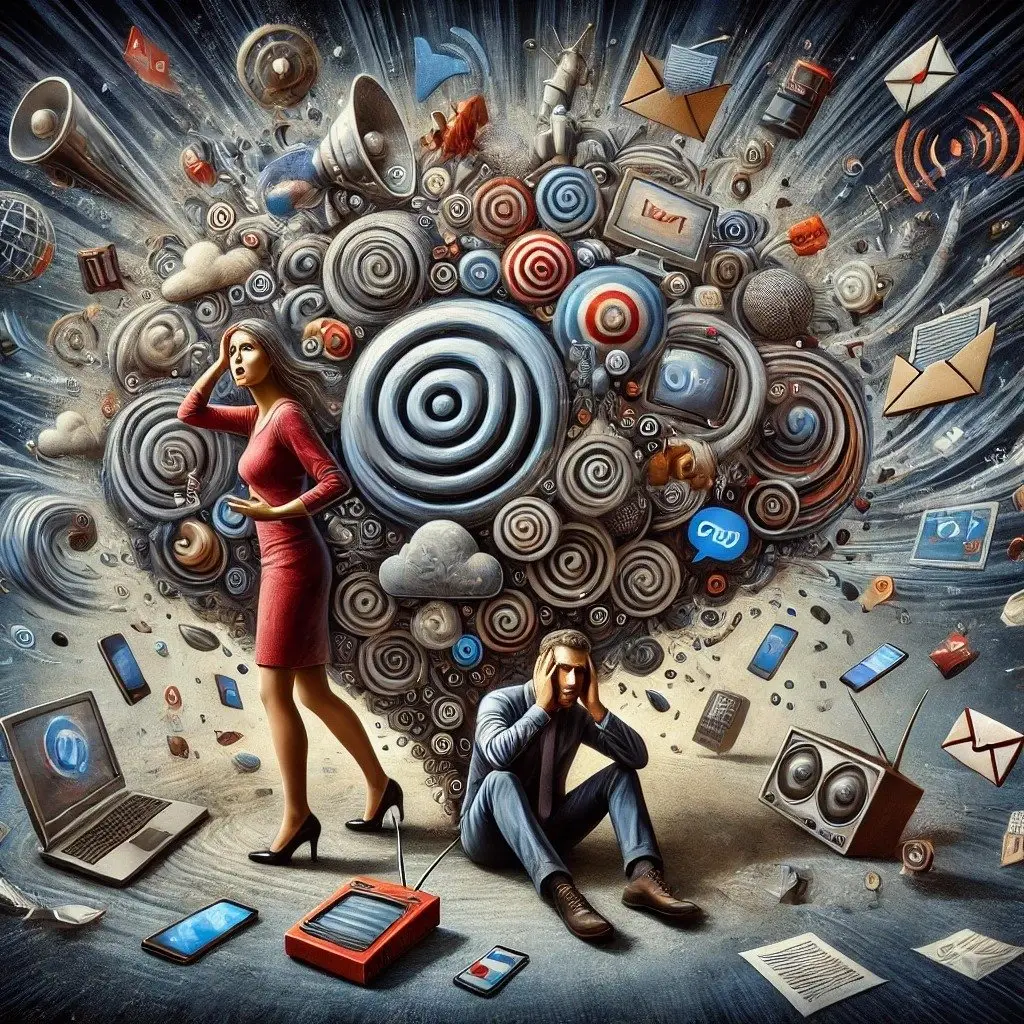
Your brain isn’t designed for the digital age. This article explains the cognitive biases and logical fallacies that make us vulnerable to disinformation.
“Look at this, it’s incredible! We must share it now!” The message outrages us. Our heart beats faster. Without thinking twice, we hit the share button. Minutes later, we discover it was false. Too late! The news is already circulating among hundreds of contacts.
This situation leads us to ask: why, regardless of education or experience, is it so easy to fall into these mental traps? The answer lies in how our brain works in the digital era.
The Digital Labyrinth
Our brain receives enormous amounts of information daily but only processes a small part. To avoid collapse, it uses mental shortcuts: automatic patterns that simplify reality. Psychologist Daniel Kahneman called these System 1 (fast, intuitive) and System 2 (slow, analytical). In the digital world, where speed is everything, System 1 predominates, leaving us exposed to distortions.
Cognitive Biases: The Mind’s Mirages
Kahneman identified several biases that facilitate disinformation:
- The Illusion of Truth: Constant repetition of a statement, even if false, increases our perception of its truth. This is why political propaganda repeats slogans endlessly.
- Confirmation Bias: We seek information that confirms our existing beliefs and dismiss what contradicts them. Algorithms amplify this by creating “filter bubbles” where we only see aligned ideas.
- Anchoring Bias: We give excessive weight to the first information we receive on a topic.
- The Dunning-Kruger Effect: We overestimate our knowledge in unfamiliar areas, making us prone to accept simple explanations for complex problems.
- Availability Bias: We judge probability based on how easily we recall examples, which is why shocking news distorts our risk perception.
Logical Fallacies: Reasoning Errors
Beyond biases, logical fallacies make us susceptible:
- False Dichotomy: Presenting extreme options as the only possibilities.
- Ad Hominem: Attacking the person instead of their argument.
- Slippery Slope: Suggesting a change will lead to inevitable catastrophe.
- Straw Man: Distorting an opponent’s argument to make it easier to attack.
- False Balance: Presenting two positions as equal when one has far more scientific support.
The Emotion Factory
In the digital age, emotions amplify these effects. “Surveillance capitalism,” a term coined by Shoshana Zuboff, describes how digital platforms design systems to capture attention and guide behavior. Every click generates data about our preferences and vulnerabilities, which is used to keep us hooked on emotionally charged content—regardless of its truth.
From Soldiers to Explorers
Psychologist Julia Galef proposes a new way of relating to information. We can face it as soldiers, defending our beliefs at all costs, or as explorers, recognizing our cognitive limitations and developing strategies to overcome them.
The explorer mindset means questioning our own beliefs, actively seeking diverse information, and cultivating empathy for those who think differently. The good news is that with practice, we can learn to identify our biases and detect fallacies, allowing us to evaluate information more critically.